

If your trustee is using trust assets for personal benefit or cannot explain where the money went, you may be dealing with a breach of fiduciary duty that requires legal action.
In many cases, beneficiaries must take legal action to force the trustee to account and recover assets the trustee took from the trust.
At The Grossman Law Firm, we regularly speak with beneficiaries who suspect something is wrong but do not yet have clear proof. Before we discuss why trustees misuse assets, let’s look at how these situations develop, when they become legal problems, your options, and how The Grossman Law Firm can help.
Why Trustees Misuse or Withhold Trust Assets
Not every issue starts as intentional wrongdoing.
In some cases, a trustee may claim they are:
- Gathering and valuing assets
- Handling property sales
- Paying debts or expenses
- Managing ongoing trust administration
However, problems arise when the trustee:
- Cannot explain where the money went
- Fails to keep records
- Uses trust assets in ways that benefit themselves or their family
Under California law, a trustee cannot use trust property for personal gain. The duty of loyalty requires a trustee to act solely in the beneficiaries’ interests.
When that line is crossed, it becomes a serious legal issue.
When a Trustee Must Account
A trustee’s duty to provide information is not optional.
Under California Probate Code §§16060 and 16062, a trustee must:
- Keep beneficiaries reasonably informed.
- Respond to reasonable requests for information.
- Provide a formal accounting at least annually or upon request in many situations.
An accounting should show:
- What assets came into the trust?
- What did the trustee spend?
- What remains?
- Who benefited from those transactions?
If a trustee cannot or will not provide this information, that is a major warning sign.
A trustee does not get years to figure it out. Further, once administration is underway, they are expected to keep records and explain their actions.
Common Warning Signs
Beneficiaries often notice patterns before they see proof.
Watch for:
- No accounting for extended periods of time.
- Real estate is being sold with no explanation of the proceeds.
- Trust funds that cannot be traced.
- A trustee is acquiring assets that they could not otherwise afford.
- Family members living in trust property without paying rent.
- Vague or shifting explanations when questions are asked.
As a result, these situations often point to deeper issues with how the trust is being handled.
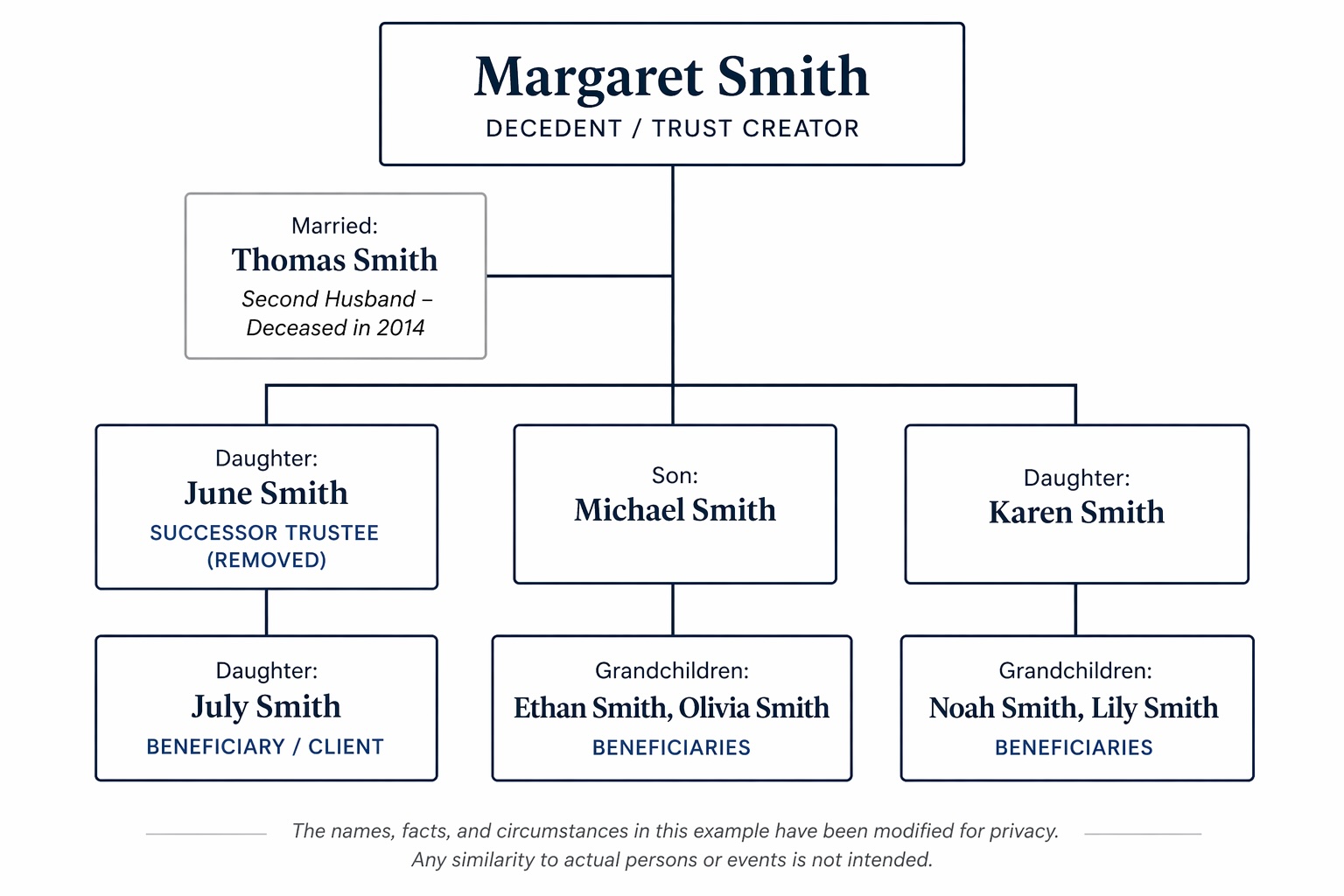
A Real-World Example: The Smith Family Trust
The names, facts, and circumstances in this example have been modified for privacy.
Our client, July Smith was a beneficiary of her grandmother’s trust. Margaret Smith created a trust with her second husband. He passed in 2014 and Margaret’s daughter, June Smith, became the successor trustee. Margaret had shown signs of cognitive decline as early as 2012 and was placed in memory care by 2015. She never actively served as the trustee. Margaret’s trust beneficiaries were her grandchildren through her three children.
Trust Assets and Early Red Flags
Once June took control, she managed several trust assets, including a home in Riverside, proceeds from the sale of a Tustin property, and other liquid funds that should have been tracked and reported. Also, a family member was living in the house without June ever showing the rental income in any accounting.
Over time, things stopped adding up.
Our client July, June’s daughter, started asking straightforward questions:
- What happened to the proceeds from the Tustin sale?
- Were trust funds used to purchase other property for the trust?
- Why has no accounting been provided?
July did not receive meaningful answers from the trustee. July contacted TGLF when she realized her mom has been taking money.
What initially looked like a delay turned into something more serious.
Once litigation began, the pattern became clear. The trustee had been taking money from the trust over the last few years, in small amounts, without disclosure or the required accounting.
The Grossman Law Firm petition was filed to suspend and remove the trustee for failure to conduct their fiduciary duties. The court granted the petition, and June was removed.
From there, the focus shifted to recovery.
The beneficiaries pursued a surcharge for the trustee’s wrong-doing. Moreover, a surcharge is a court-ordered judgment requiring a trustee to repay losses caused by a breach of fiduciary duty.
After collecting the surcharge and selling the property, the beneficiaries got their equal split of about $1.5 million, including past rents.
This is how these cases often unfold. What starts as missing information can turn into years of undisclosed activity. Once the trustee is forced to account and the court steps in, the full scope of the damage becomes clear—and recovery becomes possible.
What You Can Do
In many situations, legal action may be necessary to uncover the truth and recover the assets the trustee owes you. You may need to file a court petition to compel an accounting or seek removal of the trustee if you suspect misuse or refusal to account.
Before more time passes, contact The Grossman Law Firm to evaluate your options.
Gather as much information as you can from the list below. We use this information to evaluate your case.
- What do you expect to inherit? Is it a percentage or a specific asset?
- What trust assets do you know about? Real estate, bank accounts, or prior sales?
- Has any property been sold? If so, when and for how much?
- Do you have any accounting or financial records?
- Who is currently living in trust property, and under what arrangement?
- What communication have you had with the trustee?
If The Grossman Law Firm could represent you in collecting your inheritance, our intake specialists will collect your relevant documents and schedule a free phone consultation with our attorneys.
Why Timing Matters
Delays tend to make these cases worse.
As time passes:
- A trustee may spend or transfer trust funds.
- It becomes harder to trace financial records.
- Real estate may be sold or encumbered.
- The paper trail becomes more difficult to reconstruct.
In cases involving misuse of funds, trustees may slowly withdraw funds over time, making it harder to detect without formal legal action. As a result, early action can make a significant difference in what you can ultimately recover.
FAQ
Can a trustee use trust money to buy property?
No, a trustee cannot use trust assets for personal benefit. Doing so may constitute self-dealing and a breach of fiduciary duty.
What if the trustee refuses to provide an accounting?
You can file a petition in probate court to compel an accounting. Courts can also suspend or remove a trustee who refuses to comply.
Related Resources
- Overview of California Trust Litigation
- 20 Ways Your Trustee Can Be Breaching Their Fiduciary Duties
- What Happens If a Trustee Does Not Follow the Trust?
- Can You Remove a Trustee for Mishandling Assets?
- Can’t Afford a Probate or Trust Attorney?